Surviving the SWE market
If your strategy for the 2026 software market is more applications, you are competing where the conversion rate is the lowest. The way out is not more applications. It is everything around them.
If you are graduating into the 2026 software job market and your plan is to mass-apply, the math is not on your side. Funnel conversion is bad at every stage right now, and sending the 401st application is the lowest-leverage move on the board. It is also the easiest one to confuse with progress, which is part of why it eats so many weeks.
What has worked, for me and for the small group of new-grads I keep comparing notes with, is leaning the other direction entirely. Spend the hours you would have burned on the 401st application building things, talking to people, and looking measurably sharper every two weeks.
What to actually do
I do not love list-shaped advice, but these five do compound.
- Pay for an AI coding assistant. Cursor, Claude Code, whichever fits your editor. It is roughly twenty dollars a month, and it is the highest-leverage subscription a junior engineer can buy right now. It is not a substitute for skill. It is a much faster feedback loop for building the skill.
- Build the projects that genuinely interest you, especially the ones above your current level. If the project feels comfortable on day one, you picked the wrong one. The point is not to ship something polished. The point is to spend three weeks struggling with a system you actually want to understand. The polish follows.
- Read the AI output before you accept it. An assistant you do not push back on is a fast way to ship code you cannot defend in an interview. Read every diff. Ask why this approach. Refactor when it is wrong. Look up the unfamiliar primitives. Your CS degree was preparation for exactly this kind of literate reading.
- Go where builders gather, in person. Hackathons, meetups, demo nights, indie founder events. One real conversation with a founder, an early engineer, or a fellow new-grad who is also building gets you further than five hundred cold applications. The introduction problem is the part the market is solving worst right now. Solve it in person.
- Update your resume every two weeks. Not because anything dramatic needs to change. Because the discipline of asking, every fourteen days, what did I ship that belongs on the page, is a much better forcing function than scheduling time to job-search.
Why this works in this market
AI did not eliminate the entry-level engineer. It eliminated the entry-level engineer who only knows how to consume tutorials. The path to a first job used to be: get the degree, send the applications, hope. The path now is: get the degree, ship the stuff, build the small reputation, then send the applications. The order is doing most of the work.
The hiring side has shifted in parallel. Founders and engineering managers are pattern-matching on this person actually builds far faster than on this resume has the right keywords. A public side project that someone can open and click around is closer to a screening pass than a cover letter ever was.
What nine months looked like
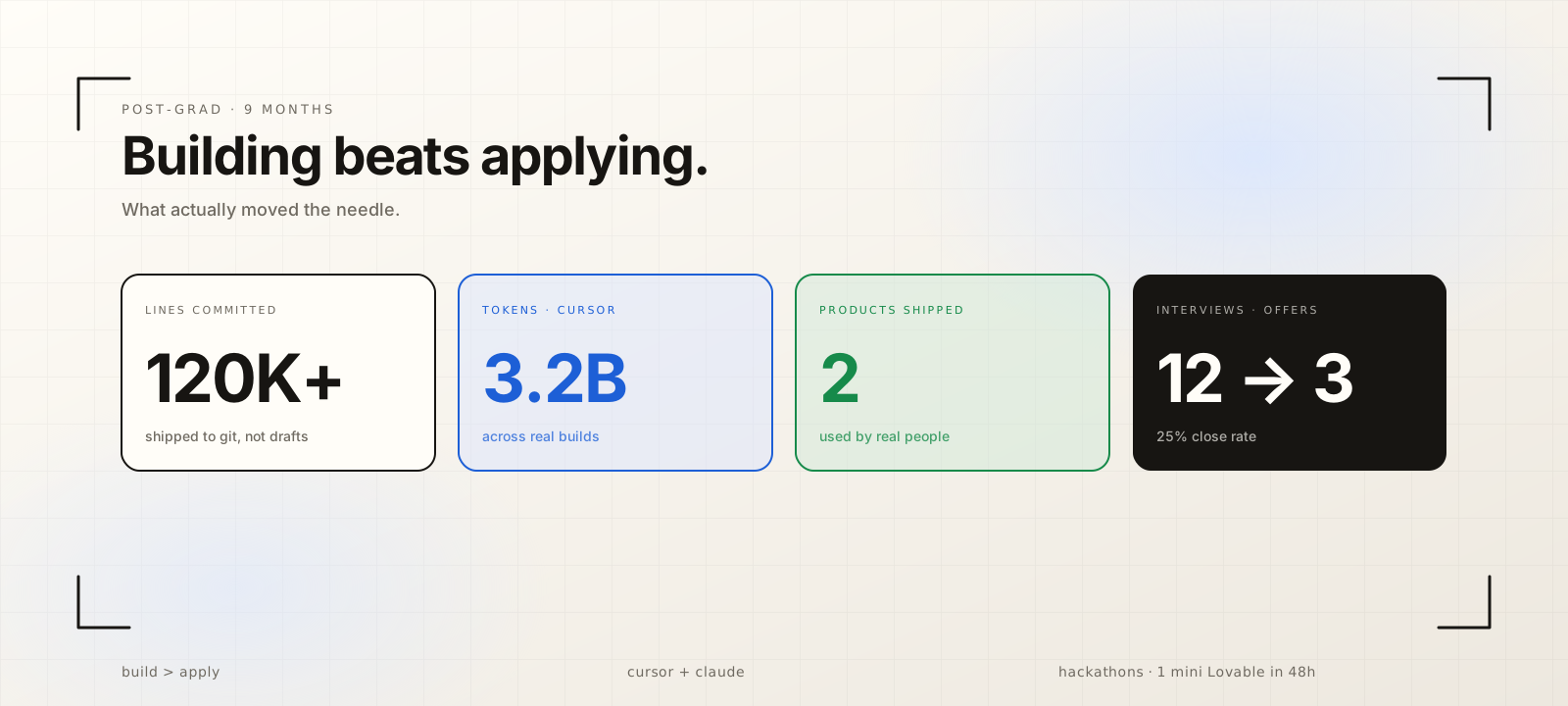
For context, the numbers from the last nine months since I walked off the graduation stage:
- Roughly 120,000 lines of code committed to git.
- Two products shipped and being used by real people.
- About 3.2 billion tokens through Cursor alone.
- A short list of real relationships with founders and engineers at Cursor, Buildclub, and a handful of early-stage teams.
- Multiple hackathons, including a weekend where I built a small Lovable-style clone in 48 hours.
- Twelve interview loops. Three offers.
These are not bragging numbers, they are accounting. The point is that the strategy is reproducible. None of it required a top-five school, a previous brand-name internship, or a network I started with. It required spending the same hours building that the average new-grad spends refreshing a job board.
The honest part
AI has lowered the barrier to building further than most people have updated for. The honest version of I do not know how yet has aged out as an excuse. Pick a project that scares you a little. Open the editor. Start tomorrow, or start today.
References
- 01Cursor · cursor.com
- 02Claude Code · claude.com
- 03Lovable · lovable.dev
- 04Buildclub · buildclub.ai
Reach out
If something here resonated, I'd love to hear what you're building. Always open to a good conversation.