Introducing Schedia.ai
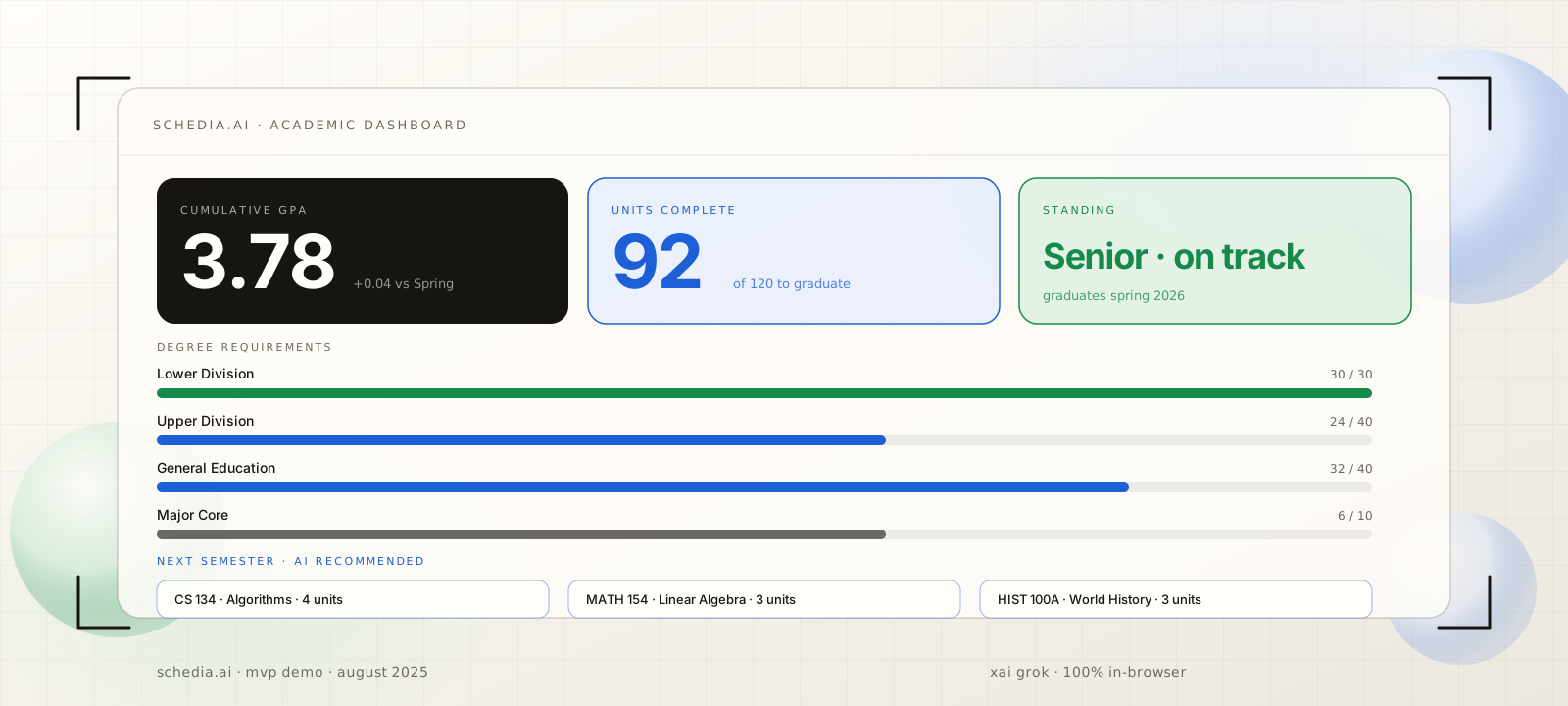
An AI-powered academic advisor that reads a transcript PDF in the browser and turns it into live GPA, requirement progress, and a real recommendation for next semester. No degree audit appointment required.
After several months of work, the Schedia.ai MVP is live. It is an AI-powered academic advisor that helps students instantly understand where they stand academically and plan what to take next. No paid degree audit. No waiting on a counselor's calendar. No spreadsheet that quietly gets out of date by week three.
The mechanic is simple. You upload your transcript PDF. The platform reads it locally, extracts the course history, and uses xAI's Grok to turn that data into something you can actually use: live GPA, requirement progress, and a real recommendation for the next semester.
The agent
The Schedia.ai agent does the thinking on top of the parsed transcript:
- Real-time GPA calculation and academic standing analysis, updated every time a new course is added.
- Personalized course recommendations and semester planning based on what is missing for the degree, not a generic catalog ordering.
- Automatic tracking of lower-division, upper-division, and general education requirements, so the picture stays honest as you check things off.
Smart data handling
Transcript PDFs are stubbornly inconsistent across schools. Schedia.ai goes out of its way to fail gracefully:
- Extracts only the four things that actually matter: course codes, titles, units, and grades.
- A robust PDF.js parser that holds up across whatever variant of transcript a university hands out.
- Error-resistant design that handles OCR artifacts and formatting variations without falling over.
- Grade validation, passing-grade filtering, and duplicate detection so the math stays honest even when the input is not.
Privacy-first by default
A transcript is the most personally-identifying academic document a student has. Sending it to a remote server for parsing made no sense for the product, and made even less sense for the user. Doing the parsing in the browser was a constraint at the start. It quickly became the answer.
The dashboard
Once the data is parsed, the rest is a dashboard that explains itself:
- Visual progress bars for each degree requirement category, so nothing is hidden under a tab.
- Real-time GPA and unit deficit tracking, with the standing classification (sophomore, junior, senior) updating live.
- AI-generated course paths to stay on track, including alternates when the obvious pick is full.
- Semester-by-semester planning, with the option to compress timelines for students who want to graduate sooner.
The UI: my best work so far
I will admit some pride here. The dashboard is the cleanest UI work I have shipped to date.
- Glassmorphism panels that feel translucent without becoming illegible.
- Immersive 3D backgrounds powered by Three.js, used as ambient depth rather than decoration.
- Smooth Framer Motion animations that hold up over long sessions instead of feeling busy.
- Fully responsive across desktop, tablet, and mobile, because students plan from whatever device is on the bed at midnight.
Why this exists
Most universities ship some flavor of degree audit, but the experience usually feels like opening a tax form. Slow, jargon-heavy, and not built for the moment a student actually needs guidance, which is usually right before registration opens at midnight. Schedia.ai is built to feel like having an academic advisor in your pocket. Fast. Private. Always available.
This MVP is the first version of that experience. There is plenty more on the roadmap, including richer institution-specific support, prerequisite chain visualization, and a study-companion mode for the courses themselves. More soon.
References
- 01xAI Grok · x.ai
- 02PDF.js · mozilla.github.io
- 03Three.js · threejs.org
- 04Framer Motion · framer.com
Reach out
If something here resonated, I'd love to hear what you're building. Always open to a good conversation.